Eczema On The Scalp: Symptoms and Treatment
Eczema on the scalp causes redness, intense itching, and flaking skin. The most common form is seborrhoeic dermatitis, which triggers an inflammatory reaction to natural skin yeasts. Managing your symptoms involves using medicated shampoos, moisturising the scalp to repair the skin barrier, and choosing gentle hair care products. Over-the-counter treatments can often clear mild flare-ups, but persistent or severe cases need prescription therapies from a doctor.
A persistently itchy, flaky, and sore scalp can be incredibly frustrating to live with. It can affect your sleep, your confidence, and how you care for your hair. Scalp eczema is a very common condition, and you are not alone in finding it difficult to manage. Understanding your specific symptoms and what triggers them is the first step towards feeling more comfortable. Managing the condition involves a clear plan, from choosing the correct active ingredients in shampoos to adapting your daily hair routines.
What is eczema on the scalp?
Scalp eczema is a long-term inflammatory skin condition that causes the skin on your head to become persistently itchy, flaky, dry, and red. It is entirely harmless to others and is not contagious, though it will often flare up for a period and then settle down.
The most common form is seborrhoeic dermatitis. NHS (local service) notes that seborrhoeic dermatitis is a common scaly rash affecting the scalp and may involve an inflammatory reaction to Malassezia yeasts. These are harmless yeasts that live naturally on everyone's skin, but in some people, they trigger an immune response that leads to inflammation and rapid shedding of skin cells.
The skin barrier
Your skin barrier acts as a protective shield. A healthy skin barrier keeps irritants out and locks essential moisture in. In people with eczema, this barrier becomes weakened and porous. This weakness allows moisture to escape, leaving the scalp dry, and allows external triggers like hair products or sweat to enter and irritate the skin. NHS (local service) states that using a moisturiser (emollient) helps repair the skin barrier and protects it. Supporting this barrier is a crucial part of long-term scalp care.
What are the symptoms of scalp eczema?
The symptoms of scalp eczema primarily include persistent itching, flaking, redness, and a dry or sore scalp.
Common symptoms
Scalp eczema can present in several ways, and your symptoms may change depending on how severe a flare-up is. NHS (local service) explains that scalp seborrhoeic dermatitis can cause redness, flaking, itching and dandruff.
The main symptoms to watch out for include:
- Persistent itching, known medically as pruritus.
- Flakes or scales, which may be dry and white, or greasy and yellow.
- Changes in skin colour and visible inflammation.
- A burning sensation or general soreness across the scalp.
- Weeping fluid or crusting, which often happens in severe flares or if the skin becomes infected.
- Greasy or waxy patches of skin.
Symptoms on different skin tones
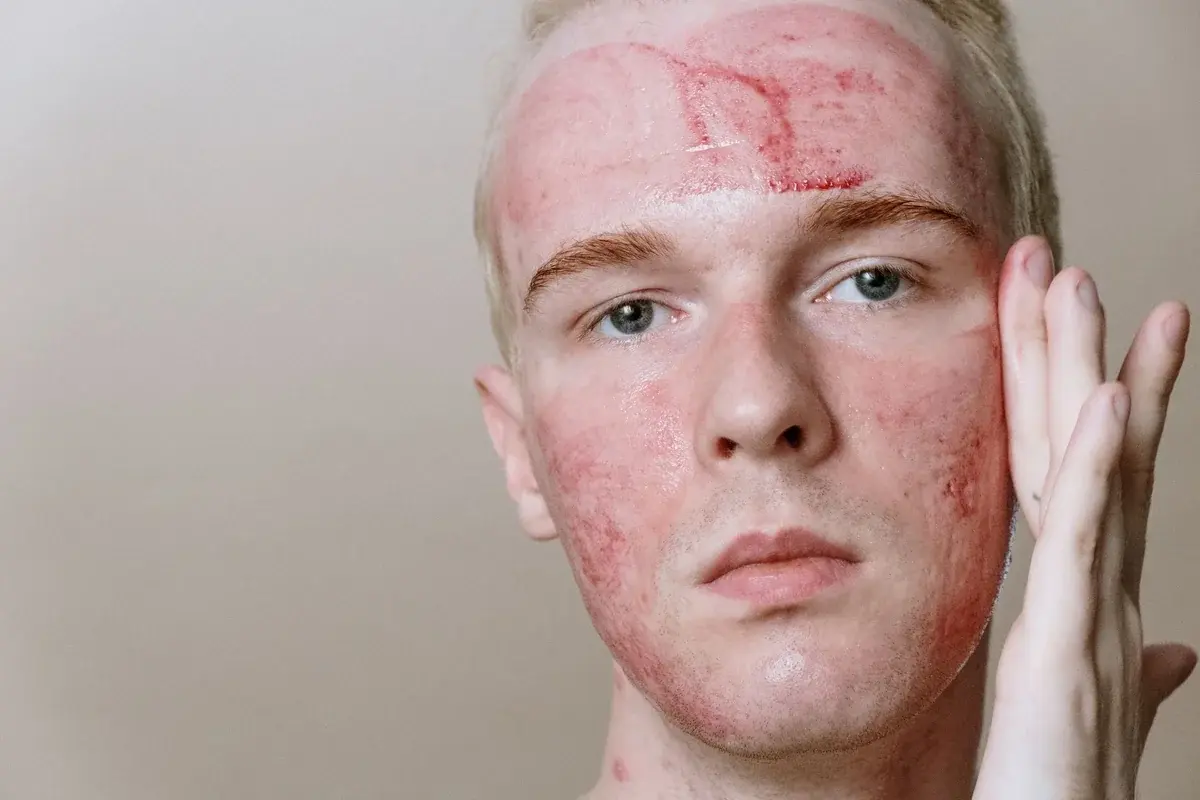
Inflammation on the scalp appears differently depending on your skin tone. On lighter skin tones, eczema typically looks red or bright pink. On darker skin tones, redness is often less obvious. Instead, the eczema may look dark brown, purple, or ashen grey. Because colour changes can be harder to spot under hair and on darker skin, focusing on other key indicators like flaking, crusting, and severe itching is essential for identifying a flare-up.
Symptoms on different hair textures
Your hair type can also change how you experience and spot scalp eczema.
- In afro-textured hair: Flakes may become trapped easily, and skin build-up often occurs right at the base of the hair shafts.
- In fine or oily hair: The scalp may appear particularly greasy, with yellowish scales sticking tightly to the skin and hair roots.
- In thick hair: The sheer volume of hair can hide visible inflammation entirely. You may need to rely on the physical sensations of itching, burning, and soreness to monitor your condition.
The different types of eczema on your scalp
The different types of eczema on your scalp include seborrhoeic dermatitis, atopic eczema, and contact dermatitis.
Seborrhoeic dermatitis
Seborrhoeic dermatitis is the most frequent cause of scalp eczema. It is closely linked to an overgrowth of, or sensitivity to, the Malassezia yeast on the skin. It causes classic symptoms of dandruff alongside greasy, yellowish scales and inflamed skin. This type of eczema thrives in areas with many oil-producing glands, so you may also notice similar flaky, red patches on your face, eyebrows, chest, and back.
Atopic eczema
Atopic eczema is the most common type of eczema globally. NHS inform states that atopic eczema can affect the scalp, particularly in children. The symptoms are typically much drier and itchier than seborrhoeic dermatitis. It is often seen alongside patches of eczema elsewhere on the body, such as the creases of the elbows and knees, and is strongly associated with other atopic conditions like asthma and hay fever.
Contact dermatitis
Contact dermatitis happens when a specific substance touches the scalp and causes a reaction. There are two forms. Irritant contact dermatitis is caused by harsh chemicals, such as the sodium lauryl sulphate (SLS) found in many shampoos, stripping the skin barrier. Allergic contact dermatitis is an immune reaction to a specific ingredient, like artificial fragrances or paraphenylenediamine (PPD) found in permanent hair dyes. Symptoms usually appear shortly after exposure and are limited to the areas where the product touched the skin.
Scalp eczema vs psoriasis
Scalp psoriasis is another common inflammatory condition that is frequently confused with seborrhoeic dermatitis. They require different treatments, so telling them apart is important.
|
Feature |
Scalp Eczema (Seborrhoeic Dermatitis) |
Scalp Psoriasis |
|---|---|---|
|
Scale appearance |
Fine, yellow, greasy flakes |
Thick, silvery, white scales |
|
Borders |
Ill-defined edges that blend into skin |
Well-demarcated, distinct sharp edges |
|
Colour |
Red or yellowish base |
Salmon-pink or deep red base |
|
Other affected areas |
Face, eyebrows, chest, skin folds |
Knees, elbows, lower back, nails |
How to treat eczema on the scalp
Treating eczema on the scalp involves using over-the-counter medicated shampoos, applying prescription steroid creams during flare-ups, and managing dry scales with emollients.
Choosing over-the-counter shampoos
Medicated shampoos are the first-line treatment for managing scalp eczema. NHS (local service) explains that ketoconazole shampoo is an antifungal treatment commonly used for scalp seborrhoeic dermatitis and should be used according to its product instructions. Different shampoos contain different active ingredients, and choosing the right one depends on your primary symptoms.
|
Active Ingredient |
How it Works |
Best For |
Example UK Brands |
|---|---|---|---|
|
Ketoconazole |
Antifungal that reduces Malassezia yeast |
Seborrhoeic dermatitis |
Nizoral, Dandrazol |
|
Selenium sulphide |
Antifungal that slows skin cell turnover |
Moderate flaking and itch |
Selsun |
|
Coal tar |
Reduces inflammation and scaling |
Thick scales and severe itch |
T/Gel, Capasal |
|
Salicylic acid |
Exfoliates and lifts dead skin |
Breaking down thick scales |
Capasal, Neutrogena T/Sal |
Using prescription treatments
When over-the-counter shampoos are not enough to control a flare-up, a GP may prescribe a topical corticosteroid. NHS (local service) explains that topical steroid creams reduce inflammation in the skin and reduce the appearance of redness.
Scalp steroids often come as lotions, gels, or mousses that are easier to apply through hair than thick creams. It is important to use the correct amount. NHS (local service) provides guidance on this: "Squeeze the topical steroid in a line from the last finger crease to the fingertip. This is a fingertip unit (FTU)." Your GP will advise how many FTUs you need for your scalp. NHS (local service) notes that management commonly includes avoiding triggers, using daily emollients and topical corticosteroids during flares.
Managing scaling and dryness
Thick scales can block treatments from reaching the inflamed skin beneath. You can manage this by using an emollient or natural oil (like coconut or olive oil) as a pre-shampoo treatment. Massage the oil gently into the scalp to soften the skin, leave it on for a few hours or overnight under a shower cap, and then wash it out with your medicated shampoo. Never pick or aggressively scratch the scales, as this breaks the skin barrier further and invites bacterial infection.
Hair care with scalp eczema
Caring for your hair with scalp eczema requires gentle washing techniques, avoiding harsh chemical treatments, and carefully selecting non-irritating styling products.
Washing and conditioning hair
Washing your hair requires a gentle approach during an eczema flare. Always use lukewarm water, as hot water strips natural oils and worsens inflammation. When applying shampoo, massage it into the scalp gently using the pads of your fingertips, completely avoiding the use of your nails.
Keep conditioner away from your scalp. Apply it only to the lengths and ends of your hair. Check the labels of your daily washing products carefully. NHS (local service) suggests avoiding irritating or fragranced hair products may help. Look for hypoallergenic hair care ranges free from sodium lauryl sulphate and alcohol.
Using styling products
You can use styling products, but you must be cautious. Always do a patch test with a new gel, mousse, or spray on a small area of skin behind your ear before using it fully. Opt for water-based products rather than alcohol-based ones, as alcohol is highly drying. When styling, try to apply the products only to the hair shafts, keeping them as far away from the scalp skin as possible.
Colouring and chemical treatments
Chemical processes like bleaching, perming, and permanent colouring are major triggers for contact dermatitis and can severely aggravate existing scalp eczema. If you decide to colour your hair, you must do a patch test at least 48 hours before every single treatment, even if you have used the same dye before. Tell your hairdresser about your scalp condition before your appointment so they can take extra care. We strongly advise avoiding all chemical treatments entirely while you are experiencing an active flare-up.
Heat styling and hair loss
Use hairdryers on a cool or warm setting only, and avoid holding the nozzle close to your scalp. Direct heat can trigger itching and dry out the skin barrier.
Many people worry about hair loss when dealing with scalp eczema. The eczema itself does not cause permanent baldness. However, persistent, aggressive scratching can damage the hair follicles and snap the hair shafts, leading to temporary thinning. Once the inflammation is treated and the scratching stops, the hair will typically grow back normally.
When to see a GP about your scalp eczema
You should see a GP about your scalp eczema if your symptoms are severe, disrupt your sleep, show signs of infection, or do not improve with over-the-counter treatments.
Red-flag symptoms
While many cases of scalp eczema can be managed at home, you should seek medical advice if your symptoms cross a certain threshold. See a GP if:
- Your symptoms have not improved after two to three weeks of using over-the-counter medicated shampoos.
- The itching is severe and disrupting your sleep, work, or daily life.
- Your scalp is weeping fluid, crusting over, or feels very painful and hot (these are signs of a bacterial infection).
- Your symptoms are spreading rapidly to your face or neck.
- You are experiencing sudden or significant hair loss.
Medical assessment and treatment
A doctor can properly examine your scalp to confirm the diagnosis and rule out conditions like psoriasis or fungal ringworm. If necessary, they can prescribe stronger, prescription-only treatments such as topical steroids to treat your scalp eczema. .Our online GPs regularly help patients manage chronic skin conditions and can assess your scalp symptoms quickly in a video appointment, creating a tailored care plan for you. For very severe or resistant cases, a GP can also refer you to a dermatologist for specialist care.
Getting expert help for your scalp eczema
Getting expert help for your scalp eczema ensures you find an effective treatment plan when home remedies are not enough. Managing eczema on the scalp takes time and patience, but taking control of your daily routine makes a significant difference. Identifying your specific symptoms ensures you choose the correct over-the-counter shampoo. Supporting your skin barrier with emollients, adapting how you wash your hair, and avoiding harsh chemical styling products will help keep flare-ups at bay.
If your scalp is sore, weeping, or not responding to pharmacy shampoos, you do not have to put up with the discomfort. Our virtual GPs are experienced in diagnosing skin conditions and can help you find a treatment plan that works for you. Book an appointment today to discuss your symptoms and get the support you need.
Frequently asked questions
Scalp eczema is not exactly the same as dandruff, although both cause flaking skin. Simple dandruff causes light flaking without significant underlying inflammation. Scalp eczema, specifically seborrhoeic dermatitis, involves severe inflammation, redness, soreness, and intense itching alongside heavier scaling.
Your scalp eczema keeps coming back because eczema is a chronic, long-term condition with no permanent cure. However, by identifying your personal triggers and keeping up with a gentle hair care and moisturising routine, you can effectively manage the condition and reduce how often flare-ups happen.
The fastest way to temporarily soothe an itchy scalp from eczema is to apply a cool, damp compress to calm the nerve endings. However, the most effective fast treatment is using a prescribed topical steroid or your medicated shampoo to actively reduce the underlying inflammation causing the itch.
Stress can indeed make your scalp eczema worse, as it is a very common trigger for all types of eczema. High stress levels affect your immune system and can increase inflammatory responses throughout the body, making a scalp flare-up much more likely. Finding ways to manage your stress is an important part of your overall skin care.