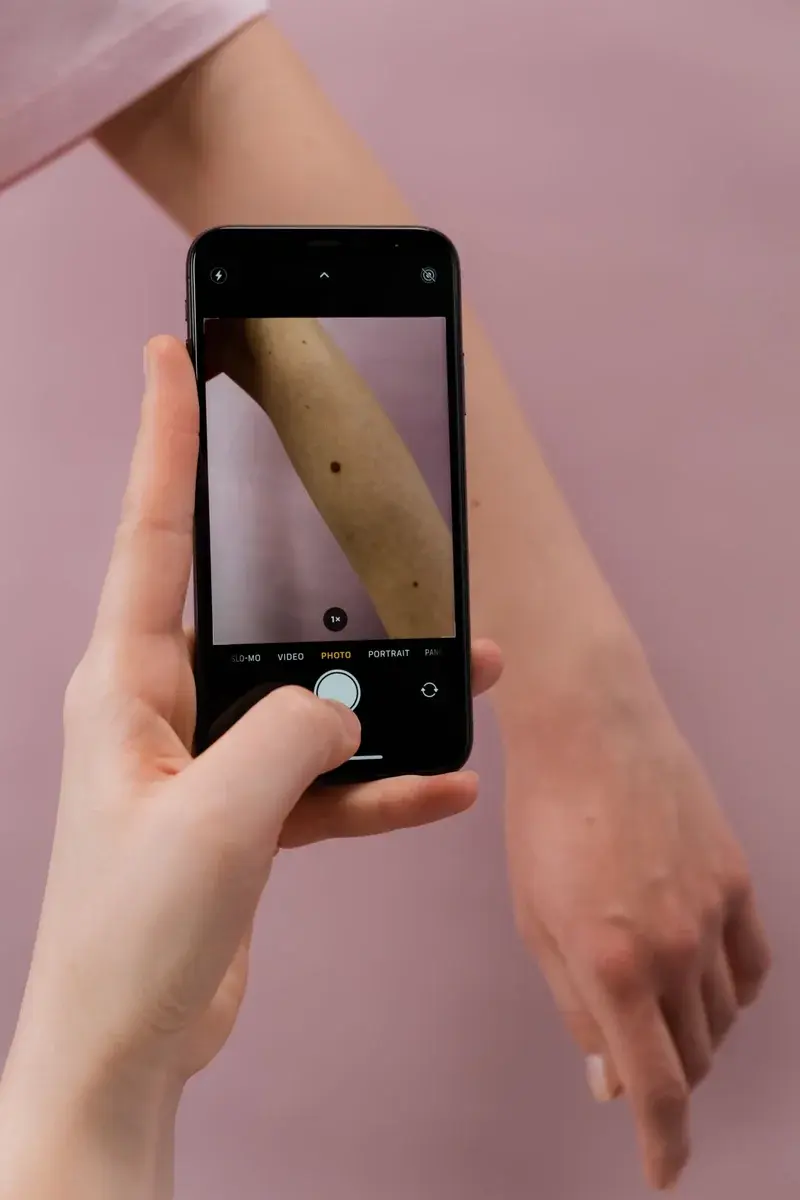
Full Body Mole Check: Who Needs One And What It Covers
A full body mole check is a preventative examination by a doctor to find early signs of skin cancer, especially melanoma. People with risk factors like a family history of skin cancer, numerous moles, or fair skin that burns easily benefit most. You should also check your own skin monthly using the ABCDE rule for any changes.
It is a common and understandable worry to notice a new mole, or see an old one changing. The uncertainty of whether it's a normal part of aging or something that needs a professional opinion can cause real anxiety. As GPs, we help people with these concerns every day. Below, we explain the process of a professional full body mole check, from deciding if you need one to understanding what happens during the appointment and what the results might mean. Our aim is to give you the confidence to take control of your skin health.
What is a full body mole check?
A full body mole check is a specialist examination of your skin, performed by a doctor or dermatologist. It is a thorough, head-to-toe inspection designed to identify any suspicious moles or lesions that could be early signs of skin cancer. The goal is to spot any worrying changes at the earliest possible stage, when skin cancer is most treatable.The primary purpose of a mole check is detect changes early.
The purpose of a professional skin examination
The primary purpose of a mole check is preventative. It is a proactive health assessment aimed at the early detection of skin cancer, particularly malignant melanoma, which is the most serious type of NHS.
In our virtual consultations, a common question is whether a person needs to check their whole body if they are only worried about one mole. A full examination is important because it covers areas you cannot easily see yourself, such as your back, scalp, and the soles of your feet. A clinician can systematically review your entire skin surface to identify any concerning spots you may not have noticed.
The role of dermoscopy in a mole check
A key part of any professional mole check is the use of dermoscopy. This involves the clinician using a handheld magnifying instrument called a dermatoscope to examine your moles.
A dermatoscope uses polarised light and high-powered magnification, allowing the doctor to see structures beneath the surface of the skin that are invisible to the naked eye Cancer Research UK. This detailed view helps the clinician to assess the patterns and features within a mole. It is an essential tool for differentiating between benign (harmless) moles, also known as naevi, and suspicious lesions that may require further investigation, such as a biopsy. This technology significantly improves diagnostic accuracy compared to looking with the naked eye alone.
Who should have a professional mole check and how often?
A professional mole check is most beneficial for individuals who have an increased risk of developing skin cancer. While anyone can develop melanoma, certain factors can make it more likely.
A checklist of key risk factors
You may have a higher risk of developing skin cancer and could benefit from regular professional checks if you have one or more of the following risk factors, based on NHS and Cancer Research UK guidance:
- A personal history of skin cancer: Having had a melanoma or another type of skin cancer before increases your risk of developing another.
- A family history of skin cancer: If a close relative (parent, sibling, or child) has had melanoma, your risk is higher.
- Having many moles: People with a large number of moles are at greater risk.
- Having atypical moles: These are moles that look unusual, are often large and have irregular borders or uneven colour.
- Fair skin that burns easily: If you have pale skin, freckles, and red or blonde hair, you are more susceptible to sun damage NHS.
- A history of severe or blistering sunburns: Sunburn, especially during childhood, significantly increases your risk.
- A weakened immune system: This can be due to a medical condition or certain medications (immunosuppressants).
What is the recommended frequency for checks?
There is currently no single national screening programme for skin cancer in the UK. Therefore, the decision on how often to have a professional mole check depends entirely on your individual risk profile.
For people with a low risk, regular self-monitoring at home may be all that is needed. You do not necessarily require routine professional checks unless you notice a specific change.
For individuals with one or more significant risk factors, a GP or dermatologist may advise a regular full body check. This is often recommended on an annual basis, but the frequency could be more or less often depending on your specific circumstances. This should always be a personalised decision made in discussion with your doctor, who can help you weigh the benefits based on your personal and family history.
How to perform a monthly skin self-check at home
Performing regular self-checks at home is the most important thing you can do for your skin health between professional appointments. Checking your skin once a month helps you to become familiar with it and spot any new moles or changes to existing ones early.
The ABCDE rule for spotting suspicious moles
The ABCDE rule is a simple, effective guide used by doctors and recommended by the NHS to help identify the common features of a melanoma NHS (local service). When you check your moles, look for:
- Asymmetry: One half of the mole does not match the other half. Normal moles are usually symmetrical.
- Border: The edges are irregular, ragged, blurred, or notched. Benign moles typically have smooth, even borders.
- Colour: The colour is not uniform. It may have multiple shades of brown or black, or patches of pink, red, white, or blue.
- Diameter: The spot is larger than 6mm across (about the size of the end of a pencil). While melanomas can be smaller, most are this size or larger.
- Evolving: The mole is changing in any way: in size, shape, colour, or becoming raised from the skin.
Not all melanomas follow the ABCDE pattern. A new, firm, raised lesion that continues to grow should also be assessed.
Understanding the 'ugly duckling' sign
Another very helpful method for spotting a suspicious mole is the 'ugly duckling' sign. This concept is simple: for most people, their normal, benign moles tend to look similar to one another. They might be different sizes, but they generally share a similar pattern or 'family' appearance.
An 'ugly duckling' is a mole that looks significantly different from the others on your body. It might be darker, lighter, larger, smaller, or just have a different structure. This outlier mole should be considered suspicious, even if it does not fit all the ABCDE criteria perfectly. It is a simple but effective rule that can help draw your attention to a potential problem.
A step-by-step guide to checking your whole body
To do a thorough check, you will need good lighting, a full-length mirror, and a handheld mirror.
- Start with your head and neck: Examine your face, nose, lips, and mouth. Use a comb or hairdryer to part your hair and inspect your entire scalp. Do not forget to check behind your ears and the back of your neck.
- Check your torso: Examine your chest and stomach. For women, be sure to check the skin underneath your breasts.
- Inspect your arms and hands: Look at the front and back of your arms, your underarms, and check your palms, the back of your hands, and in between your fingers. Also, check your fingernails for any new, dark streaks.
- Examine your back: Turn your back to the full-length mirror and use the handheld mirror to inspect the back of your neck, your shoulders, and your entire back, right down to your buttocks.
- Check your legs and feet: Sit down and check the front and back of your legs. Finally, inspect the soles of your feet, the skin between your toes, and check your toenails.
As you become more familiar with your skin, you will be better able to notice when something is new or changing. You may find it helpful to check your moles at home regularly.
Mole check vs mole mapping: what’s the difference?
A clinical mole check is a point-in-time assessment by an expert, while digital mole mapping is a technology-led surveillance service that tracks changes over time. While the terms are often used interchangeably, they refer to two different services, and understanding the difference can help you decide which, if any, is appropriate for you.
The clinical mole check: a point-in-time assessment
A clinical mole check is an expert examination of your entire skin surface by a dermatologist at a single point in time. The doctor will use a dermatoscope to look closely at every mole and lesion.
The focus of this assessment is to identify any moles that look suspicious right now. The dermatologist relies on their clinical experience and the patterns seen through the dermatoscope to make a judgement. They may take clinical photographs of any specific moles of concern to add to your patient record for future comparison, but this is not the main purpose of the appointment.
Digital mole mapping: photographic surveillance over time
Digital mole mapping is a technology-led surveillance service designed for individuals at very high risk of melanoma. This process involves taking a series of high-resolution digital photographs of your entire skin surface to create a baseline 'map'.
At subsequent appointments, a new set of photographs is taken. This new map is then compared to the baseline, often using specialised software, to detect any new moles or microscopic changes in existing ones that might be invisible to the naked eye. A clinician then reviews these changes. This method is particularly useful for people with many moles, as it provides an objective record of change over time.
Which service is right for you?
|
Clinical Mole Check |
Digital Mole Mapping |
|
|---|---|---|
|
What it is |
An expert examination of all moles at a single point in time. |
A technology-led service creating a photographic record of your skin to track changes over time. |
|
Who it's for |
Anyone with a specific concern about a mole, or for a general check-up, especially if you have risk factors. |
Individuals at very high risk, such as those with a strong family history, many atypical moles, or a previous melanoma. |
|
Technology used |
Dermatoscope. |
Total body photography system combined with a dermatoscope. |
|
Main benefit |
Provides an immediate expert opinion on any suspicious moles present on the day of the examination. |
Detects subtle new moles or microscopic changes in existing moles over months or years. |
When to see a GP about a mole
You should see a GP about a mole if it shows any 'red flag' signs, such as changes that fit the ABCDE rule or a mole that becomes itchy or bleeds. While most moles are harmless, early detection of skin cancer is key, so it is vital to get any concerns checked without delay.
Red flag signs you shouldn't ignore
You should book an appointment to see a GP as soon as possible if you notice any of the following signs, as recommended by the NHS:
- A mole that is changing in line with the ABCDE rule (Asymmetry, Border, Colour, Diameter, Evolving).
- A mole that has become itchy, tender, or started to bleed, ooze, or crust for no obvious reason.
- Any new skin lesion or mole that appears especially if it looks unusual or is growing quickly.
- A dark line or patch of colour under a fingernail or toenail that has not been caused by an injury.
What to do if you are worried
If you have any of the symptoms above, or are simply worried about a mole, you should book a GP appointment. Our online GPs can assess a mole during a video consultation. It can be very helpful to take clear, well-lit photographs of the mole beforehand to show the doctor.
Reassure yourself that the vast majority of moles that are checked turn out to be harmless. However, it is always safest to have a professional opinion. Explain your concern to the GP ; if you describe a changing mole, you may be offered an urgent appointment with a specialist.
When to get urgent help
See a GP urgently if:
* You have a mole that has changed in size, shape, or colour.
* You have a mole that has become itchy, painful, is bleeding, or has become crusty.
* You have a new mole or growth that you are worried about.
Our online GP service is not an emergency service. If you or someone else is seriously unwell, call 999 or go to A&E.
What to expect at your mole check appointment
At a mole check appointment, you can expect the doctor to discuss your medical history, review moles with a dermatoscope, and then explain the findings. Knowing what to expect can help you feel more prepared and less anxious about the appointment, whether it is with a GP or a specialist dermatologist.
How to prepare for your appointment
A little preparation can help the doctor get the clearest possible view of your skin, ensuring a thorough and accurate examination.
- Remove cosmetic coverings: Arrive at your appointment without any makeup, fake tan, or nail polish on your fingers or toes. These products can hide the true colour of your skin and nails, making assessment difficult.
- Wear appropriate clothing: Choose loose, comfortable clothing that is easy to remove, as the doctor will need to examine your entire body.
- Note your concerns: Think about any specific moles you are worried about beforehand. It can be helpful to make a note of where they are and when you first noticed them changing, so you can point them out to the doctor.
- Know your history: Be ready to discuss your personal and family medical history, including any past skin cancers, as well as your typical sun exposure habits and history of sunburn.
During the consultation and examination
The appointment will usually begin with a conversation. The clinician will ask about your risk factors, your history of sun exposure, and about any specific lesions that are worrying you.
Following this, the physical examination will take place in a private room. You will likely be asked to undress down to your underwear, and a gown or sheet will be provided for your comfort and dignity. The clinician will then systematically inspect your skin from head to toe, including your scalp, palms, soles, and between your fingers and toes. They will use a dermatoscope to look at moles and other spots in detail. The examination itself is painless.
Understanding the possible outcomes
After the examination, the clinician will discuss their findings with you. There are typically three main outcomes:
- Reassurance: In the vast majority of cases, the examination will show that your moles are benign and no further action is needed. The doctor will advise you to continue monitoring your skin at home.
- Monitoring: The clinician may identify a mole that they would like to keep an eye on. They might take a photograph for your records and ask you to book a follow-up review in a few months to check for any changes. If the mole changes or you notice new symptoms before then, speak to a GP sooner.
- Biopsy/Removal: If a mole or lesion is considered suspicious for skin cancer, the clinician may recommend that it is surgically removed for laboratory analysis. This is known as an excisional biopsy. It is a minor procedure usually performed under local anaesthetic, and it is the only way to get a definitive diagnosis.
Taking the next step for your skin health
Taking care of your skin is a lifelong commitment. The key takeaways from this guide are that regular monthly self-checks are important and understanding your personal risk factors helps you know when to seek professional advice. A professional mole check provides an assessment that can offer a skin review or valuable peace of mind.
We encourage you to make monthly skin checks a part of your normal health routine. Get to know what is normal for your skin, and do not hesitate to speak to a doctor if you notice anything new, changing, or just not quite right.
If you're worried about a mole, you can often book a GP appointment for the same day. Book an appointment with a Doctor Care Anywhere GP today.
Frequently asked questions
A highly experienced doctor using a dermatoscope can be very accurate at identifying suspicious moles. Dermoscopy provides strong clues about whether a lesion is likely to be benign or malignant. However, a definitive diagnosis of melanoma skin cancer can only be confirmed by sending a removed mole to a laboratory to be analysed under a microscope by a pathologist. This process is called histopathology.
The cost of a private full body mole check can vary depending on the clinic and its location. If a mole needs to be removed for a biopsy, this and the subsequent laboratory analysis will involve an additional cost.
A routine mole check is not covered by the NHS as part of a national screening programme. However, if you are worried about a specific mole, your GP can examine it. If they suspect skin cancer, they can refer you to a dermatologist on the NHS for further assessment NHS.
The '2 week wait' is an NHS target in England. If your GP suspects you might have cancer, they can make an urgent referral for you to see a specialist. The aim is for you to have your first appointment with the specialist, in this case a dermatologist, within two weeks of the referral being made. This is to ensure that any potential cancer is diagnosed and treated as quickly as possible.
Yes, mole checks are important for people of all skin tones. While skin cancer is more common in people with fairer skin, it can affect anyone. It is important to know that skin cancers can present differently on darker skin. They sometimes appear in areas that get less sun exposure, such as the palms of the hands, the soles of the feet, under the nails, or in the mouth. A professional check can help identify these 'hidden' lesions.